
Press Conference Statements Not Legally Binding: When a Chief Minister's Word Is Not the Government's Bond.

Updated: May 27
Can a Chief Minister's word from a podium become a right you can enforce in court?
The Delhi High Court has a clear answer and it may surprise you.
In a landmark ruling delivered on April 6, 2026, the Delhi High Court settled a critical constitutional question: a promise made by a Chief Minister during a press conference does not constitute a legally enforceable obligation in the absence of any formal policy or statutory backing. The case arose from a 2020 COVID-19 lockdown assurance by former Delhi CM Arvind Kejriwal, but its implications reach far beyond that moment in history. This ruling draws a firm line between political speech and legal duty a distinction every citizen, tenant, and policymaker must understand.

What Was the Promise That Sparked This Legal Battle?
Four days into the nationwide lockdown, on March 29, 2020, the Delhi Chief Minister held a press conference requesting landlords to postpone the collection of rent from poor and poverty-stricken tenants, further stating that the Government would pay rent on behalf of tenants unable to do so due to poverty.
Migrant tenants and affected residents took this promise seriously. When the State failed to act on it, a writ petition was filed before the Delhi High Court. In its ruling passed on July 22, 2021, the single judge held that a promise or assurance given by the Chief Minister in a press conference amounts to an enforceable promise and that a CM is expected to exercise his authority to give effect to such a promise. The Government of NCT of Delhi challenged this finding and the Division Bench has now overturned it.
Is There a Difference Between a Politician's Promise and a CM's Statement?
Yes and the Court drew this distinction carefully. The Court noted that at the highest, the failure to abide by promises made by a politician prior to his election to public office may only affect, adversely, his public image and perhaps future success in elections.
However, the Court acknowledged that an elected representative's public statement carries a different weight. A statement made by an elected representative such as the Chief Minister on a public podium is qualitatively different, wearing an entirely different complexion compared to a statement made by the same politician before his election to public office.
Despite this elevated moral weight, the Court was firm: moral weight alone does not translate into legal enforceability.
Why Are Press Conference Statements Not Legally Enforceable?
The core reason lies in the absence of official documentation. As the assurance to pay the rent out of State funds was not translated to any written document, Office Memorandum, Notification, Circular, or any other instrument having the force of law, it cannot be enforced merely because it was made in a statement during the press conference.
The Division Bench of Justice C. Hari Shankar and Justice Om Prakash Shukla expressed regret over this gap, noting the circumstances were "extremely unfortunate" and that the State Government ought to have translated the assurance into a written document to give it legal form and sanctity.
What Is a Writ of Mandamus And Why Does It Matter Here?
A writ of mandamus is a judicial order compelling a public authority to perform a duty imposed on it by law. The Court clearly laid down: a mandamus can issue only to compel performance of a duty which the State or public authority is required in law to perform if no such legal liability exists, no writ of mandamus can issue.
Since there was no statutory provision, policy document, or official circular backing the CM's press conference promise, there was no "legal duty" for the Court to enforce. The writ petition was therefore held to be misconceived.
What Protections Do Migrant Tenants Still Have?
The Court was not entirely unsympathetic to tenants. In view of the DDMA Order of March 2020, which has never been challenged, landlords cannot be allowed to recover rent from their migrant tenants for the period during which they continued to occupy the tenanted premises but were unable to move out owing to the COVID-imposed lockdown. This protection, however, applies only for the duration the lockdown remained in force.
Way Forward:
The Delhi High Court's ruling in Government of NCT of Delhi v. Najma & Ors. is a watershed moment in understanding the limits of political promises under Indian constitutional law. This judgment underscores that public Press Conference Statements are not legally binding, no matter how senior the official or how urgent the crisis.. For a government's promise to become an enforceable right, it must be translated into a formal policy instrument: a notification, circular, office memorandum, or statutory order. Citizens cannot be faulted for trusting their elected leaders, but courts of law operate on legal instruments not political goodwill. This ruling is a call to action for governments everywhere: if you make a promise, back it with paper.
Lawttorney.ai Search Prompt
"Can a Chief Minister's public statement or press conference promise be enforced as a legal right through a writ petition under Indian constitutional law?"
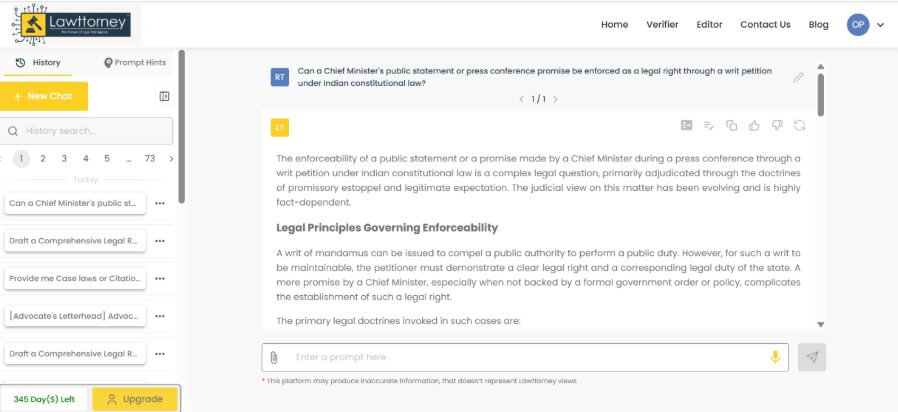
Lawttorney Insight: When you search this query on the Lawttorney tool, it is likely to surface relevant precedents and constitutional principles around legitimate expectation, the doctrine of promissory estoppel against the State, and the scope of Article 226 writ jurisdiction. The Lawttorney response, read alongside this article, provides a comprehensive picture: while courts have occasionally recognized the doctrine of legitimate expectation in administrative law, the Delhi High Court's ruling reinforces that such expectations must still be grounded in a formal legal framework to be judicially enforceable. Together, the case law surfaced by Lawttorney and the analysis in this article can help litigants, students, and practitioners understand precisely when the State's word becomes the State's law and when it simply does not.
Frequently Asked Questions (FAQs)
Can any statement by a government official be enforced in court?
Not automatically. For a government statement or assurance to become legally enforceable, it must be backed by a formal policy instrument such as a notification, office memorandum, or circular. A verbal or press conference statement, even by a Chief Minister, does not by itself create a legal duty enforceable through a writ petition.
What is the difference between a political promise and a legal obligation?
A political promise is a public commitment made by an elected representative that may carry moral weight but lacks legal force unless converted into law or official policy. A legal obligation is a duty prescribed by statute, contract, or formal government order that courts can compel the State to perform.
Can the Delhi Government still choose to pay rent to the migrant tenants?
Yes. The Court clarified that nothing in its ruling prevents the State Government from taking a fresh policy decision to honor the former Chief Minister's assurance should it choose to do so. The ruling only holds that no court can compel the State to do so in the absence of a formal policy.
What is a writ of mandamus and when can it be issued?
A writ of mandamus is a court order directing a public authority to perform a specific legal duty. It can only be issued when there is a clear, existing legal obligation on the authority. Where no such obligation is created by law, policy, or statute, the writ cannot be granted.



Comments