
Supreme Court Draft Regulations on AI: What Every Lawyer and Litigant Must Know

The Supreme Court Draft Regulations on AI mark a watershed moment in India's legal history. On June 3, 2026, the Supreme Court published the draft "Regulations for Use of Artificial Intelligence (AI) in Courts, 2026," prepared under its AI Committee, and has invited comments and suggestions from stakeholders and the general public until June 20, 2026. This framework seeks to balance technological advancement with the inviolable principles of human judgment, judicial independence, and constitutional rights. For legal professionals already using AI-powered tools like Lawttorney.ai for research and drafting, these regulations offer critical clarity on where the boundaries now lie.

Is the Judiciary Finally Ready to Embrace AI But on Its Own Terms?
The draft regulations establish a framework for responsible AI adoption in the judiciary based on principles of human primacy, transparency, accountability, data protection, and judicial independence. In essence, the Supreme Court is not rejecting AI it is taming it.
The proposed regulations are intended to govern the use of AI in judicial, adjudicatory, and administrative functions of the Supreme Court, High Courts, tribunals, and statutory commissions performing adjudicatory functions. This wide sweep signals that the framework is not merely aspirational but operationally binding across India's entire court hierarchy.
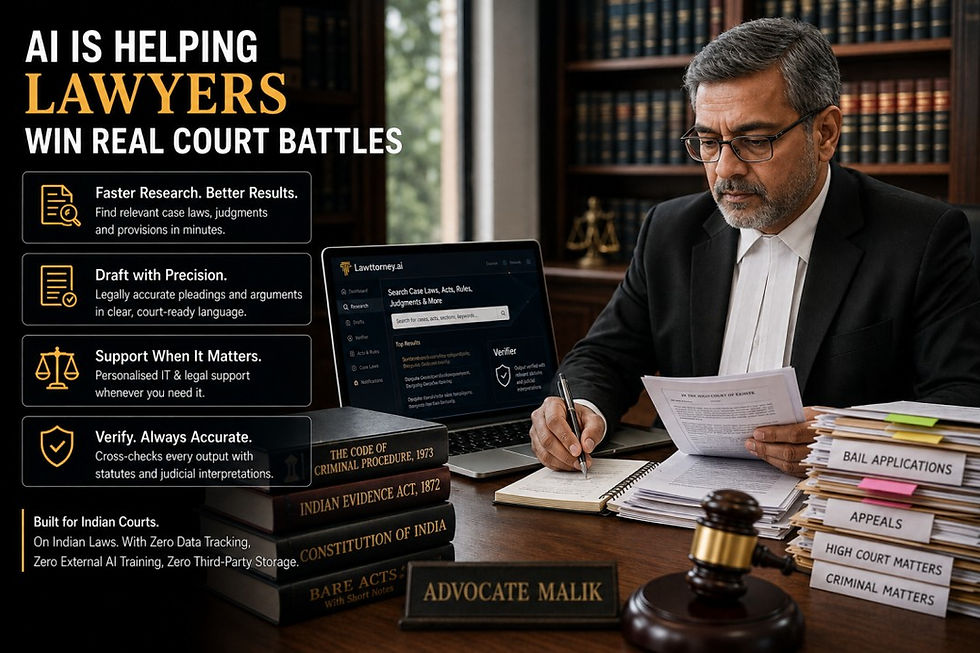
This is precisely where tools like Lawttorney.ai become indispensable. As AI regulation in courts evolves rapidly, lawyers need a reliable, updated legal research companion that helps them stay ahead of new compliance obligations, draft accurate filings, and verify citations all within the bounds the Supreme Court is now setting.
Where Can AI Actually Help And What Tasks Has the Court Approved?
Not all AI use is equal, and the draft makes careful distinctions. The regulations permit the use of AI for a range of functions including case management, scheduling, cause-list preparation, transcription of proceedings, translation of legal documents, legal research, citation verification, document summarisation, accessibility services for persons with disabilities, anonymisation of judgments and court records, and administrative functions.
However, most such uses would require prior approval and human supervision. Tools like Lawttorney.ai align naturally with this vision designed to assist lawyers in research, summarisation, and citation verification while keeping the legal professional firmly in control of every decision and submission. The regulations effectively validate the "AI as assistant" model that Lawttorney.ai is built upon.
Can AI Ever Replace a Judge? The Draft Says Absolutely Not
Perhaps the most critical provision is the unequivocal protection of human judicial authority. The draft provides that AI tools can function only in an assistive capacity and cannot replace judicial officers in determining questions of law, fact, or justice. Accountability for decisions made with AI assistance will continue to rest exclusively with the concerned judicial officer.
This principle extends equally to legal practitioners. When a lawyer uses Lawttorney.ai to research case law or draft arguments, the professional responsibility for accuracy and ethics remains entirely with the advocate exactly the standard these draft regulations seek to institutionalise across the board.
What Are the Red Lines? The Absolute Prohibitions You Need to Know
The draft draws several hard prohibitions that go to the heart of civil liberties and fair trial rights. AI systems cannot be used to independently adjudicate cases or determine judicial outcomes. The use of AI for risk scoring including predicting recidivism, assessing flight risk, determining bail eligibility, or evaluating witness credibility is expressly barred.
The regulations also prohibit AI systems from predicting future behaviour of parties or witnesses, conducting surveillance of judicial officers or litigants, or using opaque and unexplainable AI systems in matters affecting rights or personal liberty. These prohibitions reflect a deep awareness that unchecked algorithmic bias can silently undermine justice and underscore why transparent, explainable AI tools like Lawttorney.ai, which ground their outputs in verified legal sources rather than opaque black-box predictions, are better positioned to survive regulatory scrutiny.
Must Lawyers Disclose When They Use AI in Court Filings?
Yes and this is a game-changer for legal practice. The draft mandates disclosure when AI-generated content is used in court proceedings. Parties and lawyers using AI in preparing pleadings, documents, or evidence would be required to disclose such use and explain the nature and extent of AI assistance. Courts would also have the power to seek details regarding the AI system used and the verification measures adopted.
This is a direct call to action for every lawyer using AI today. Lawttorney.ai helps practitioners meet this disclosure obligation responsibly by providing source-traceable research outputs that lawyers can cite, verify, and confidently disclose to the court. The Supreme Court had earlier taken cognizance of the issue of AI-generated fake citations, and sought the responses of bar bodies on means to regulate it a problem that Lawttorney.ai's citation verification capability is specifically designed to prevent.
Who Will Watch the Watchmen? The Governance Architecture Explained
Governance is built into the framework at multiple levels. The regulations propose the creation of a permanent Apex Body at the Supreme Court comprising judges, chief justices of High Courts, technical experts, cybersecurity specialists, finance experts, and advocates with expertise in technology law. The Apex Body would be responsible for setting standards, approving AI systems, coordinating with High Courts, and publishing annual governance reports on AI use in courts.
The framework also envisages AI Committees in the Supreme Court and every High Court, dedicated AI Secretariats, periodic technical, legal, and ethical audits of AI systems, incident reporting mechanisms, cybersecurity safeguards, and specialised training programmes for judges, lawyers, and court staff. As these training programmes roll out, platforms like Lawttorney.ai can serve as practical learning tools that bridge the gap between regulatory awareness and day-to-day legal workflow helping legal professionals across India adapt to this new AI-governed landscape with confidence.
Conclusion: Supreme Court Draft Regulations on AI. A Progressive Yet Cautious Leap Forward
The Supreme Court Draft Regulations on AI represent India's most comprehensive and constitutionally grounded attempt to integrate artificial intelligence into the justice delivery system. By firmly anchoring human primacy, banning risk-scoring tools that could entrench systemic bias, and mandating full disclosure of AI-assisted filings, the framework strikes a careful balance between efficiency and fairness. For legal professionals, the message is unambiguous: AI is welcome in the courtroom, but only when it is transparent, human-supervised, and accountable. Tools like Lawttorney.ai built on exactly these principles of assisted, verifiable, and source-backed legal intelligence — are well-aligned with the regulatory direction India's judiciary is now charting. Lawyers, litigants, technologists, and civil society have until June 20, 2026 to shape this landmark policy. The time to engage is now.
Lawttorney Tool Suggested Search Prompt
Search this on Lawttorney.ai: "What are the legal implications of using AI-generated documents and citations in Indian court proceedings, and what liability does a lawyer face for AI-assisted pleadings?"

How Lawttorney.ai and This Article Work Together: While this article maps the regulatory landscape of the Supreme Court's Draft Regulations on AI, searching the above query on Lawttorney.ai will surface the case-law and professional conduct dimension relevant judgments on attorney liability, Bar Council rules on misconduct, and precedents concerning fabricated or unverified legal citations. Used together, this article and Lawttorney.ai give legal professionals both the policy framework and the litigation-ready research depth needed to navigate India's AI-regulated judiciary with full confidence.
Frequently Asked Questions (FAQs)
1. What are the Supreme Court Draft Regulations on AI and when do they apply?
These are draft rules published by the Supreme Court on June 3, 2026, governing the use of AI tools across the Supreme Court, High Courts, tribunals, and statutory commissions. They are currently open for public feedback until June 20, 2026. Legal professionals using AI tools like Lawttorney.ai should review these regulations to ensure their current practices align with the proposed framework.
2. Can AI be used to grant or deny bail under these regulations?
No. The draft expressly prohibits the use of AI for bail eligibility assessment, flight risk evaluation, recidivism prediction, and witness credibility scoring. This reinforces that AI tools must remain research and drafting aids the role Lawttorney.ai is designed to fulfill rather than decision-making systems.
3. Are lawyers required to tell the court if they used AI to draft their pleadings?
Yes. The regulations require full disclosure of AI assistance in preparing pleadings, documents, or evidence, along with an explanation of the nature and extent of such use. Courts may also demand specifics about the AI tool deployed. Lawttorney.ai's source-traceable outputs make such disclosures straightforward and professionally defensible.
4. How will compliance and misuse of AI in courts be monitored?
An Apex Body at the Supreme Court level, supported by AI Committees and Secretariats in every High Court, will oversee compliance through periodic audits, incident reporting, and annual governance reports. Legal professionals who rely on transparent, accountable AI platforms are far better positioned to meet these compliance standards.
The future of legal practice is being shaped by Artificial Intelligence—but success depends on using it responsibly. Stay ahead of regulatory changes, strengthen your legal research, and ensure every filing meets the highest standards of accuracy and compliance. Explore how Lawttorney.ai can help you work smarter while staying aligned with the Supreme Court Draft Regulations on AI.


Comments