
AI in Legal Research: Assistive Tool, Not Substitute

Introduction:
Legal research has traditionally been based on organized techniques- Boolean operators, keyword searches, citation investigations, and title searches in selected databases. These methods are essential as they offer accuracy, comprehensiveness, and credible sources. Nonetheless, with the advent of artificial intelligence, a new aspect has arisen. Search engines powered by AI aim to comprehend natural language questions and quickly display pertinent cases. The crucial question isn't if AI will substitute traditional legal search, but rather how AI in Legal Research can improve workflows by augmenting conventional approaches.

Will AI Take Over Conventional Legal Search?
The brief response: Negative. AI in legal research enhances traditional legal research instead of substituting it. Every method possesses distinct advantages, and the most successful process integrates elements from both. Organized search provides accuracy and management, whereas AI search speeds up idea-driven and investigative inquiries.
Why Do Attorneys Continue to Depend on Conventional Search?
Conventional legal research tools are designed for organized queries. Attorneys utilize Boolean operators (AND, OR, NOT), proximity indicators, and phrase searches to obtain specific case results.
Accurate Retrieval: When an attorney is aware of the citation—such as [2018] 7 SCR 379 or Navtej Singh Johar vs. UOI—classic databases deliver instant outcomes.
Keyword Management: Queries such as “gender justice” AND “child custody” produce comprehensive collections of cases.
Validation: Attorneys can manually sift through and confirm precedents, guaranteeing dependability.
In these situations, AI provides minimal benefit. Retrieval continues to be the stronghold of conventional systems
In what ways does AI Search provide advantages?
AI excels in situations where inquiries are abstract or investigative.
Examples:
In recent rulings, how have courts in India understood gender justice?
In what ways do courts handle gender discrimination and the rights of women?
Conventional search has difficulty handling these extensive queries, needing several keyword combinations. AI, on the other hand, understands meaning and context, highlighting associated principles such as constitutional equality or anti-discrimination law.
In what ways can AI assist with doctrinal inquiries?
Skilled advocates typically structure inquiries based on doctrines instead of keywords.
Examples:
Guidelines on provisional orders in business conflicts.
Extent of judicial involvement under Section 34 of the Arbitration Act.
Principle of proportionality in administrative choices.
AI can examine these intricate inquiries, pinpoint applicable laws, and emphasize key precedents
Is AI Beneficial in Corporate and Business Law Research? How does AI in legal research contribute to this field?
Certainly. Corporate law inquiries frequently focus on problem scenarios instead of references.
Examples:
Repercussions of transactions with related parties lacking approval under the Companies Act, 2013.
Duties of directors as fiduciaries in financial loss situations.
Recourses for minority shareholders against abuse by majorities.
AI can swiftly correlate these inquiries with concepts such as corporate governance, fiduciary duties, and shareholder rights
Can AI Manage Fact-Based Legal Inquiries?
AI excels at handling practical, fact-based inquiries:
A provides products, B denies payment - what options are available?
Employee dismissed prior to contract expiration - what rights are relevant?
Tenant ceases rent payments but remains in the property - what legal recourse is available?
AI analyzes these situations and relates them to problems such as contract violation, unjust dismissal, or eviction. This renders AI essential for initial assessments, although ultimate validation still necessitates conventional methods.
Lawttorney Tool Prompt :
Prompt: “How have Indian courts interpreted the doctrine of proportionality in administrative decisions affecting fundamental rights?”
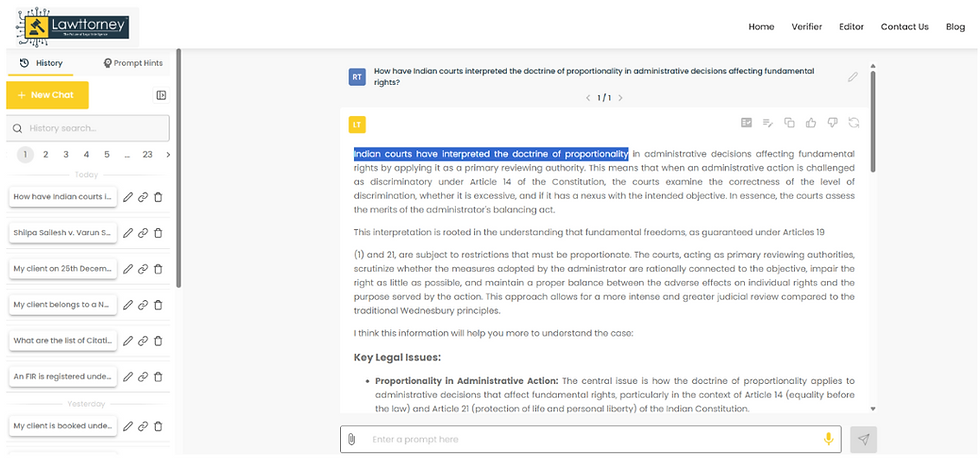
When this query is entered into the Lawttorney tool, the AI-powered system quickly surfaces leading judgments such as Om Kumar v. Union of India and subsequent cases applying proportionality in fundamental rights review. This aligns perfectly with the article theme; AI accelerates doctrinal discovery, while traditional research ensures verification. The prepared article demonstrates how such queries benefit from AI’s conceptual understanding, reinforcing the idea that AI is an assistive tool, nothttps://lawttorney.ai/ a substitute.
Way forward: AI in legal research
The future of legal research is rooted in collaboration. AI in Legal Research speeds up discovery, identifies issues, and conducts conceptual inquiries, whereas traditional searches provide accuracy, validation, and dependability. Collectively, they establish an effective process that harmonizes rapidity with precision.



Comments