
AI in Law: Can Technology Really Make Justice Fairer?

Ask a lawyer five years ago whether a machine would ever help draft their pleadings, and you'd probably get a laugh. Ask now and the answer is a lot more careful. AI in Law has moved from conference chatter into the daily routine of chambers, firms and courts. Tshilidzi Marwala, Rector of United Nations University, wrote about this shift in 2024, and his points still hold up. Here's what he said, where things can go wrong, and where Lawttorney.ai fits in.

What Is AI in Law Doing Right Now?
Quite a lot, actually. Research tools can go through huge legal databases in minutes, a job that used to eat up a junior's whole week. Chatbots give basic guidance to people who can't afford a lawyer. Drafting software handles the routine paperwork. Some tools even predict how a case might end, which helps when you're deciding whether to settle. Online dispute resolution is growing too, and for many people it beats years of waiting in court. Mostly it comes down to saving time, and time is money.
Can AI Algorithms Make Legal Decisions Fairer?
Only if we make it so. AI learns from past data, and past data carries human prejudice. Feed a system old, biased decisions and it will happily repeat them, sometimes louder. Marwala says fairness has to be planned from the start and then checked again and again, because a tool that looked fine at launch can slip later.
Who Explains the Decision When AI Gets It Wrong?
If a decision affects your life, you deserve to know why it was made. Many AI models can't really say. There's an awkward catch as well: the more accurate a model gets, the more complicated it becomes, and the harder it is to explain. That's why lawyers and technologists need to sit at the same table. A result nobody can question isn't much of a result.
Is Personal Data Safe in Legal AI Tools?
Legal files are full of private things like family fights, bank records and criminal history. Protecting that data isn't optional. Marwala points out that many African countries don't yet have the infrastructure for it, and he suggests the African Union could help by buying technology jointly so the cost is shared. Software alone won't fix the problem either. You need trained people to run it.
Will AI Replace Lawyers?
Marwala says no, and that's hard to argue with. AI should sit beside the lawyer, not in the chair. It takes the repetitive work off the desk, which leaves more time for judgment, arguing a case and understanding a client, things no software does well.
Who Writes the Rules for AI in Law?
Governments need clear laws on ethics, transparency and who is responsible when an AI system fails. Balancing that against room to innovate is hard, and it only works if regulators understand the technology themselves.
Can AI Open Up Access to Justice?
It can, if it's built for that purpose. Cheap, easy-to-find legal information helps people who've never had a lawyer. But a badly designed tool can widen the very gap it was meant to close.
How Can Lawttorney.ai Help the Legal Community?
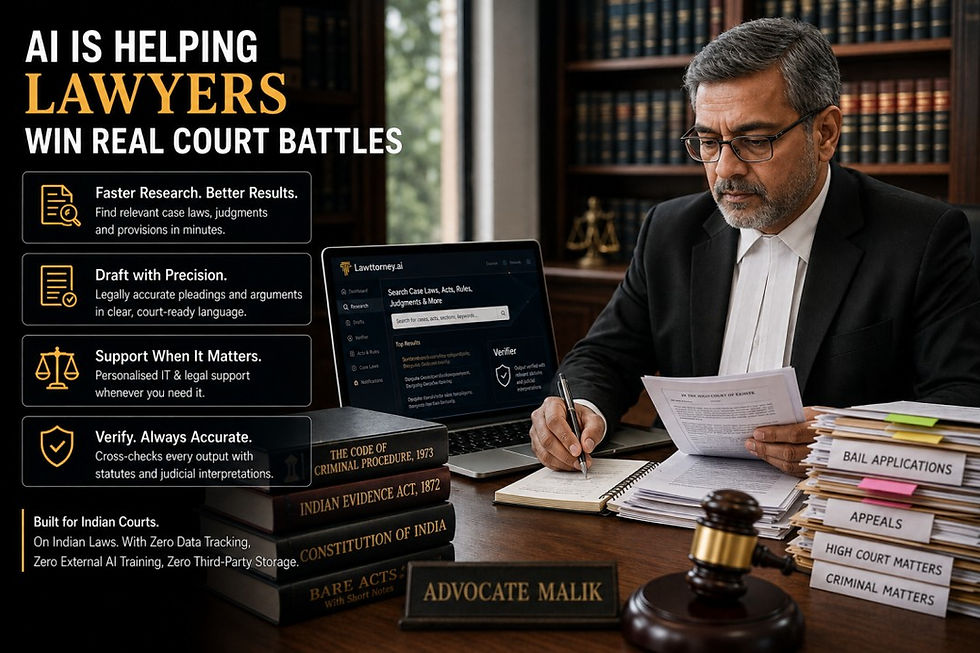
This is where Lawttorney.ai comes in. It's made by lawyers, for lawyers, and driven by Senior Advocates and Judges. It's recognised as a one-stop solution for the legal fraternity and is positioned as India's first legal AI tool that lawyers actually trust. The reason is simple: it runs on its own legal database, built from authentic sources and verified by lawyers, not scraped from wherever.
The team has also published two books, AI for Law and AI for Law 2.0. And if writing prompts feels like a hurdle, the Secret AI Prompt Book has more than 600 prompts to help advocates, judges and police use AI comfortably and without fuss.
The Way Forward: AI in Law Still Needs Human Judgment
AI in Law won't solve every legal problem, and it won't end the profession either. Used responsibly, with verified data and people watching over it, it can make the system fairer, quicker and easier to reach. Tools built by legal professionals show what that looks like in practice.
Try This Prompt for Legal AI Research
"What legal risks and safeguards apply when AI is used for legal research and document drafting in India?"

FAQs
1. What does AI in Law mean?
It means using artificial intelligence for legal work, such as research, drafting, chatbots and predicting case outcomes.
2. Will AI replace lawyers?
AI is more likely to assist lawyers with repetitive tasks than replace the full scope of legal practice. Legal judgment, advocacy, client relationships and professional responsibility remain important.
3. What makes Lawttorney.ai different?
It's built by lawyers for lawyers, on a legal database drawn from authentic sources and verified by lawyers.
4. Is there help with writing prompts?
Yes. The Secret AI Prompt Book offers 600+ prompts for advocates, judges and police.
5. Can AI make the justice system fairer?
AI can improve access to legal information and help reduce delays. However, biased training data, limited transparency and errors can create new risks. Human oversight and accountability are essential.
6. What are the risks of using AI in law?
Major risks include inaccurate legal information, biased outputs, data privacy breaches, limited explainability and unclear accountability. Legal professionals should verify AI-generated results before relying on them.
7. What are the risks of using AI in law?
Explore Legal AI. Learn Smarter. Work Faster.
Discover how AI is transforming legal research and document drafting. Explore Lawttorney.ai and join our Just-in-Time Webinar to learn how AI can support your everyday legal practice.


Comments