
The Advocate Who Learned to Prompt: How AI Is Changing Legal Work for Lawyers

It is not every day that a judge stops to compliment a piece of drafting.
The matter was a long-running auction case, the kind that accumulates volume and outlives the patience of everyone involved. The application before the court was an adjournment: routine, procedural, the sort of thing a bench reads quickly and moves past.
This one it did not move past.
Hearing the point, the judge observed that a judgment-debtor and a decree-holder are two entirely different things. It is an elementary distinction, and in execution proceedings a consequential one. It determines who may bid, who may object, and whose claim attaches to the sale proceeds. Elementary is not the same as easily got right on paper, and the confusion is common enough that benches occasionally have to say so aloud.
Then the judge turned to the submission in front of him and noted that this one was well crafted and well written.
The submission was Mr. Chavan's. The adjournment was granted. The date he received it was a long one, on a matter that had been waiting for years.
It is a small example of what AI for lawyers can look like when technology supports the work rather than replacing the lawyer behind it.

How He Got There
Mr. Chavan practises across Chandigarh, Delhi and Maharashtra. It is not the kind of practice that leaves spare days.
A written argument used to take him four to five hours. Sometimes a full day, if the research ran long, which it usually did. That is the arithmetic every litigator knows and nobody talks about: the research has to finish before the drafting can start, the drafting has to finish before the hearing, and the hearing does not move.
It now takes ninety minutes to two hours. The research that consumed the front half of that has compressed further still.
He got there by learning to work with an AI platform properly, which turns out to be a skill in itself.
The Part That Is Still His
The drafting runs across the whole of his practice. Written arguments in domestic violence matters, civil and criminal alike. Written arguments in criminal cases. Applications, procedural filings, the documents that must be correct and complete and that used to eat his evenings.
None of it happens on its own. What comes out is only as good as what he brings to it: his knowledge of the law, years of practice, and the vigilance to catch what does not belong. The output is precise because he knows what precision looks like.
Ask him about the technology and he talks first about his own discipline. Every draft passes under his eye before it goes near a filing. He drafts, he verifies, and nothing leaves the office until he is satisfied.
He is emphatic about this, and it is not modesty. It is method. He has drawn the line himself between what a machine can be trusted with and what it cannot.
What he values is that the drafts hold their line. The points are to the point. No jumps. Accuracy that survives his own scrutiny, which is the whole test. A tool that saves time but needs rewriting has saved nothing. His verification pass is a check, not a repair job, and he set that standard.
Prompting Is a Skill, and He Went and Learned It
He raises something most users never work out.
The quality of what comes out depends entirely on the quality of what goes in. The better and more precise the prompt, the better and more detailed the answer.
So he read the handbook properly rather than treating it as a formality, and set about getting good at it, the way a junior learns to structure a written argument or to find the authority that actually decides the point.
Most advocates of his standing have not bothered. He did, and the drafts show it.
The Juniors Are Learning Faster
The change he is most animated about is not his own.
His junior lawyers work the same way now, and by his estimate their efficiency has risen by around seventy per cent. But what he notices is not speed. It is that they are learning faster.
The manual labour has gone out of the work. Hours that used to disappear into locating authorities and assembling first drafts now go into research and into building their own practice: the reading and the thinking that make a lawyer over years, and the first thing sacrificed when a filing is due tomorrow.
It is a small team, and it carries more matters than it could before. More people who came looking for help are getting it.
The Part Nobody Puts in the Brochure
Asked what he would tell another advocate considering it, Mr. Chavan does not begin with the technology.
"When something goes wrong, you get a person on the line, not a ticket number. They take the call themselves and the problem is solved. That, in my view, is what sets Lawttorney apart."
For an advocate filing tomorrow morning, a tool that fails at eleven at night with no one to call is not a tool.
What Does Not Transfer
The advocate argues the case. The advocate decides what the argument is. Strategy, ethical judgement, and advocacy do not move to a machine, and Mr. Chavan would be the first to say so.
What changed is where his hours go, and what a bench happened to notice about a document in a matter that had been waiting years for a date.
About the Platform
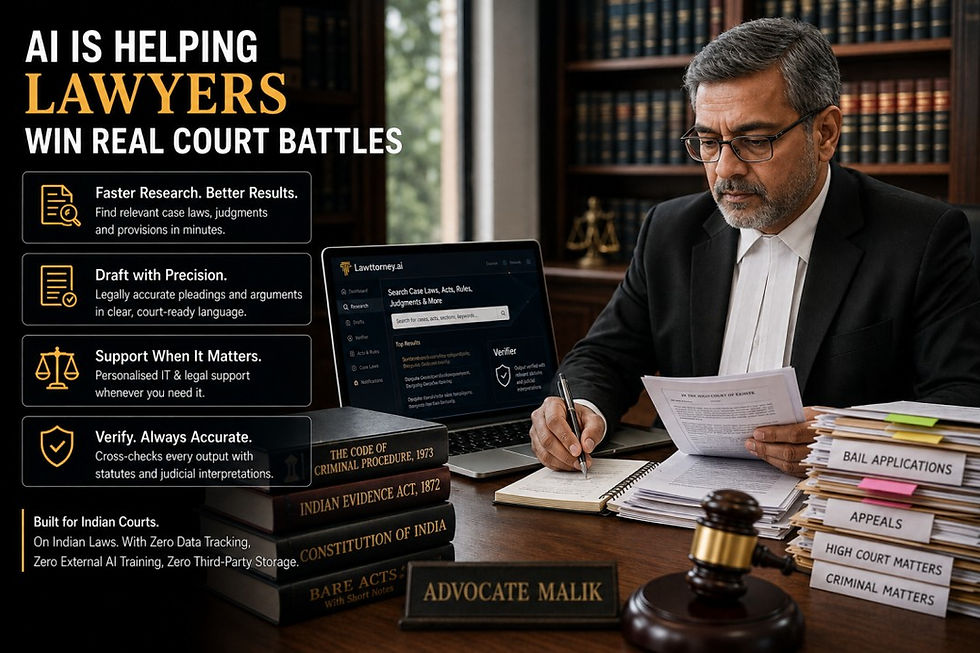
Lawttorney.ai is a World Development Corporation initiative, built, trained and engineered in India on Indian laws, statutes, case patterns, court formats and procedural workflows. Its Verifier feature cross-checks every output against the governing statutory provision or judicial interpretation. The platform operates with zero data tracking, zero external AI training and zero third-party storage.
See AI for Lawyers in Action
Want to see how AI can actually fit into your legal practice?
Join our Just in Time Webinar for a practical walkthrough of Lawttorney.ai—see how it works for legal research, drafting, written arguments and everyday legal work.
No fixed schedule. Join whenever it’s convenient for you.


Comments