
AI in the Legal Profession: How Is It Reshaping the Way Lawyers Work?

AI in the Legal Profession isn't some far-off idea anymore lawyers are already using it to research, draft, and advise clients every single day. Survey after survey shows that most legal professionals now expect AI to have a major impact on their work, and adoption is climbing fast across law firms, corporate legal teams, and even government departments. What used to make people nervous is starting to feel like table stakes. The bigger question firms are wrestling with now isn't whether to use AI, but where it actually helps and where a lawyer's judgment still has to lead.

How Is AI Changing Everyday Legal Work?
Right now, AI is making the biggest dent in the tasks nobody enjoys but everyone has to do. Document review, legal research, contract analysis, summarizing long files these are the jobs eating hours out of a lawyer's day, and they're also the ones AI handles well. Teams that have adopted these tools say work that used to take hours now takes minutes, which frees people up for the parts of the job that actually need a human brain.
Generative AI use has roughly doubled year over year at law firms and corporate legal departments, and most organizations already using it say they're seeing a real return on that investment. But speed on its own isn't the whole story. Lawyers want to know an AI tool is pulling from sources they can trust, that it's clear about how it reached an answer, and that whatever it produces will hold up in the jurisdiction they're working in. Take away that credibility and the speed doesn't count for much.
What Does AI Mean for Clients and Client Relationships?
Clients have gotten savvier about AI too, and their expectations have shifted along with it. They want faster turnaround, service that feels tailored to them, and more visibility into how their matter is being handled and a good chunk say they'd think twice about staying with a firm that's falling behind.
This is where AI is actually pulling its weight for firms: handling the routine work in the background, surfacing predictive insights that sharpen client counselling, translating in real time for clients abroad, and putting together clearer updates without someone having to write them from scratch. Even so, clients still want reassurance that the tool is secure, that it's being used responsibly, and that it isn't quietly replacing the human judgment they're actually paying for. A lawyer's real value was never in producing paperwork faster; it's in being someone clients can trust.
What Are the Biggest Concerns Around AI in Law?
None of this optimism has erased the worry. Accuracy is still the top concern for a lot of legal professionals, followed closely by data security and where exactly the ethical lines should sit. Almost everyone agrees AI has no business representing a client in court, and most think it shouldn't be handing out legal advice directly without a lawyer checking the work first.
There's a quieter worry too that leaning on AI too much, too early, could stunt how younger lawyers build their own judgment over time. That's part of why so many in the profession are pushing for clearer rules, stronger safeguards around data, and a baseline expectation that AI output has to be explainable, not just fast.
How Is AI Reshaping Future Legal Roles?
The fear that AI would simply wipe out legal jobs hasn't really played out. What's happening instead looks more like a reshuffle. Most professionals think adapting to AI is going to demand new skills being able to adjust quickly, solve unfamiliar problems, think creatively, and communicate clearly are all rising in importance. New job titles are showing up too, from AI implementation leads to in-house AI trainers to cybersecurity specialists who didn't used to sit inside legal teams.
Agentic AI is a big part of where this is headed tools that don't just answer questions but actually carry out multi-step work, like pulling relevant case law and turning it straight into a draft. Larger firms are already piloting this. But the model that's actually working keeps a human in the loop: important calls still get escalated to a lawyer, and the AI's work stays easy to check and revise.
Who Is Leading This Shift in India? A Look at Lawttorney.ai
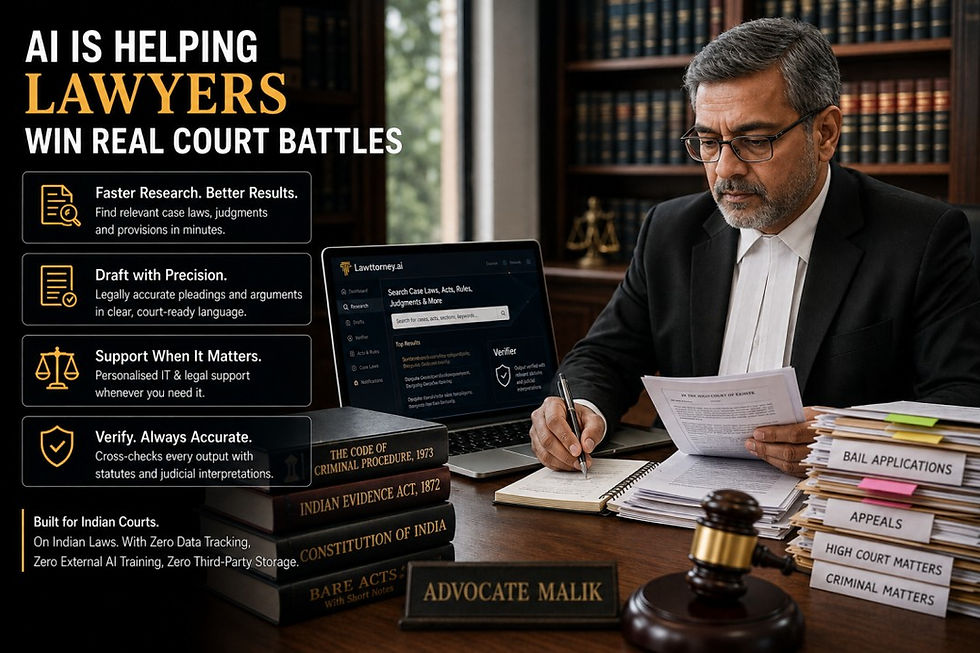
Most of the AI-in-law conversation tends to center on international players, but India has built its own name in this space: Lawttorney.ai. Described by the company as being shaped with input from senior advocates and judges rather than engineers alone, it's positioned as a one-stop legal AI solution for advocates, law firms, judicial officers, law students, and even police departments across the country.
That positioning has started to draw outside recognition, not just internal marketing. "Best of Best Review USA" named Lawttorney.ai the Best Legal AI Innovation in India of 2026, an award presented on 24 January 2026. Around the same time, CEO Times recognized the platform as the Best Ethical Legal AI Service in India of 2026, pointing specifically to its India-focused legal database, its habit of showing sources and citations alongside AI answers, and a built-in verification step that lets users cross-check an AI response against a vetted set of Indian legal questions before relying on it. The same coverage noted the platform's own guidance that its AI output isn't a substitute for advice from a qualified advocate a distinction that matters a lot in a profession this risk-sensitive.
Live Law has also featured Lawttorney.ai, framing it as part of a broader shift in legal AI: away from generic, do-everything chatbots and toward tools built specifically around how lawyers actually work researching, drafting, reviewing, and refining inside one workflow rather than several disconnected ones. That's the throughline in most of the coverage so far: Lawttorney.ai isn't trying to replace a lawyer's judgment. It's trying to earn a seat at the table by being useful in the parts of the job that eat the most time, while keeping the final call where it belongs with the lawyer.
Way Forward
AI in the Legal Profession is a real shift in how legal work gets done, not a replacement for the expertise that makes a good lawyer valuable. Firms that choose transparent, trustworthy AI tools and keep a human hand on the wheel are the ones best placed to keep clients happy, hold onto talent, and stay ahead as the profession keeps changing. Lawttorney.ai, recognized as India's Best Legal AI Innovation of 2026 and covered for its source-backed, lawyer-verified approach, is a good example of what that next chapter can look like when trust comes first.
Suggested search prompt for the Lawttorney tool:
"Summarize how AI adoption is affecting client expectations and ethical concerns in law firms, and outline what safeguards a legal AI tool should have."

How that response would relate to the article: Running this prompt on the Lawttorney tool should surface the same core themes covered in the article rising client demand for AI-enabled service, the trust/ethics requirements firms are prioritizing (data security, explainability, human oversight), and the shift toward AI as a complement rather than a replacement for lawyers. Pairing the tool's live response alongside this article lets you show readers a real-time example of "AI in the Legal Profession" in action reinforcing the article's point that credible, transparent AI tools (like Lawttorney) are what legal professionals are actually looking for, rather than generic consumer-grade AI.
FAQs
Is AI going to replace lawyers?
No. Most legal professionals see it as something that reshapes their role and takes repetitive work off their plate not something that can replace judgment, advocacy, or client counseling.
What legal tasks is AI currently best suited for?
Document review, legal research, contract analysis, and summarizing large volumes of material are where it's delivering the most consistent value right now.
What should firms look for when choosing an AI tool?
Trustworthy sources, transparency about how it reaches its answers, solid data security, and the ability to produce jurisdiction-specific work that will actually hold up.
Do clients actually care if their law firm uses AI?
More and more, yes. Clients expect the efficiency AI brings, and many are willing to walk if their firm falls behind as long as the tool being used is secure and used responsibly.
What makes Lawttorney.ai different from other legal AI tools?
It's built around India's legal system specifically, shows the sources behind its answers, and lets users verify AI output against a vetted question set which is part of why it was named Best Legal AI Innovation in India of 2026 and recognized separately as the country's Best Ethical Legal AI Service that same year.
Curious about how AI can actually transform your day-to-day legal work?
Don’t just read about it. See it in action.
Join our Just-in-Time Webinar/Demo to explore how AI can help with legal research, drafting, case analysis, and everyday legal workflows—while keeping lawyer judgment at the center.
🚀 Get a live demo. Ask questions. See what AI can do for your practice.


Comments