
ARTICLE 21 FOR FOREIGNERS: SC APPROVES BAIL RELIEF

Introduction:
In a significant ruling, the Supreme Court of India confirmed that Article 21 of the Constitution pertains equally to foreigners, guaranteeing their right to life and individual freedom. The matter concerned a Ugandan woman charged under the Narcotic Drugs and Psychotropic Substances (NDPS) Act, who stayed in prison even after the Delhi High Court granted her bail. Her failure to provide a reliable guarantee kept her imprisoned. The Supreme Court, acknowledging her financial limitations and status as a foreign national, mandated her release on a personal bond of ₹25,000, thus upholding the principle that freedom should not be restricted because of poverty or nationality.

What Prompted the Supreme Court to Get Involved?
The Court intervened upon discovering that the Ugandan woman, despite being granted bail, remained imprisoned in Tihar Jail. The challenge was her failure to offer a guaranteed solvent—a requirement set by the High Court. The panel of Justices JB Pardiwala and KV Viswanathan underscored that after bail is granted, economic challenges should not hinder an accused from obtaining freedom.
Is Article 21 Applicable to Foreign Nationals?
Certainly. The Court unequivocally declared that Article 21 of the Constitution applies to foreigners. Despite being a Ugandan citizen, the accused's inherent right to life and freedom could not be disregarded. The court noted:
"Here is a situation involving a woman who is a foreign citizen." Nevertheless, it is important to note that Article 21 of the Constitution would still be applicable to a foreign national facing prosecution as an accused in this nation.
Can Monetary Limitations Prevent Bail?
The Supreme Court explained that financial inability must not prevent bail. Bail pertains to freedom, not riches. The Court recognized that numerous defendants, especially foreign nationals, might find it difficult to provide solvent sureties. In these situations, personal connections can act as a reasonable substitute.
Article 21 for Foreigners: What Assistance Was Provided?
The Court directed her release after providing a personal bond of ₹25,000. It instructed prison officials to free her right away and move her to a detention facility while the trial is ongoing. Significantly, the Court emphasized to the trial court that guilt or innocence should be established solely based on evidence, free from any previous observations.
Wider Consequences of the Ruling?
This decision reinforces the legal principles regarding bail and freedom in India. It emphasizes three key aspects:
1. Equity before the law:
Foreigners receive the same constitutional rights as Indian citizens as per Article 21.
2. Humanitarian perspective:
Judges should take into account economic circumstances when setting bail terms.
3. Judicial awareness:
Bail must not serve as a tool for ongoing detention because of financial shortcomings.
Highlighting Lawttorney’s Response:
Prompt: “Supreme Court ruling Article 21 foreigners bail NDPS case solvent surety”
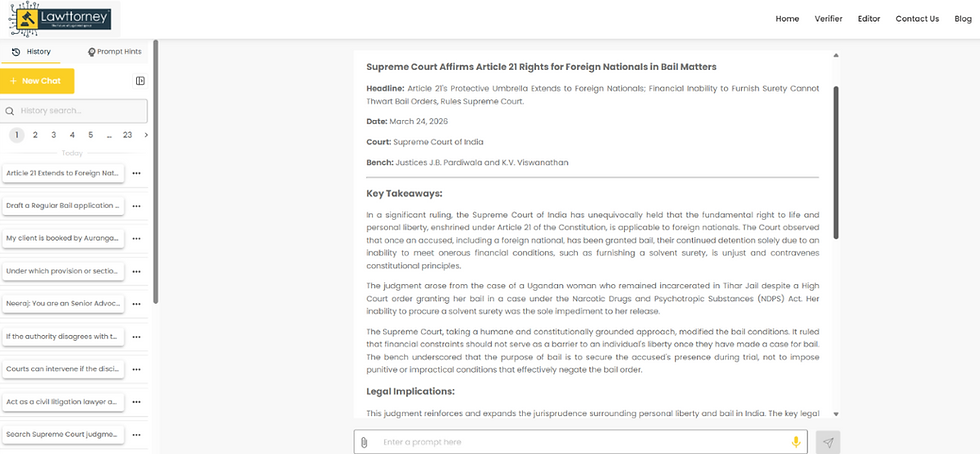
Using the Lawttorney tool, the search would provide case details, judicial observations, and implications of the ruling. The tool’s response would highlight how the Supreme Court balanced constitutional rights with practical realities of bail conditions. This complements the prepared article by offering authoritative references and case law context, strengthening the legal analysis presented.
Way forward:
The Supreme Court’s ruling on Article 21 concerning Foreigners: SC Provides Bail Relief serves as a strong reminder that freedom should not be diminished by financial limitations or national origin. By permitting release on a personal bond, the Court affirmed the core principle of Article 21 safeguarding the dignity and liberty of every person under India’s authority.
FAQs
Does Article 21 apply to foreigners in India?
Yes, Article 21 guarantees the right to life and personal liberty to all persons, including foreign nationals.
What happens if an accused cannot furnish a solvent surety?
Courts may allow release on a personal bond, ensuring liberty is not denied due to financial hardship.
Why was the Ugandan woman kept in jail despite bail?
She was unable to furnish a solvent surety, a condition imposed by the High Court, which delayed her release.
What did the Supreme Court order in this case?
The Court directed her release on a personal bond of ₹25,000 and transfer to a detention centre during trial.



Comments