
Case Study: AI in Indian Courts and Litigation Support

Introduction:
The emergence of AI in Indian courts marks a significant shift in how the justice system addresses long-standing challenges such as case backlog, procedural delays, and access to legal information. India’s judiciary, one of the largest in the world, currently faces an enormous workload. As of 2026, more than 55 million cases are pending across courts, with over 85% of these cases in district courts alone.

These numbers highlight the urgent need for technological innovation within the judicial ecosystem. Over the past few years, artificial intelligence has begun playing a supportive role in court administration, legal research, and litigation preparation. Through government initiatives and emerging legal technology platforms, AI in Indian courts is gradually transforming the way judges, lawyers, and litigants interact with the justice system.
The Challenge: Massive Caseloads in Indian Courts:
India’s judicial backlog has long been a matter of concern for policymakers and legal professionals. Data from the National Judicial Data Grid indicates that tens of millions of cases remain unresolved across district courts, High Courts, and the Supreme Court, often leading to delays that stretch over years or even decades.
Legal scholars often cite the principle “justice delayed is justice denied.” When cases remain pending for extended periods, litigants face financial strain, emotional stress, and uncertainty regarding their rights.
Several factors contribute to this backlog:
Increasing number of legal disputes
Limited number of judges relative to population
Procedural delays and adjournments
Large volumes of documentation and legal research
Artificial intelligence is increasingly seen as a tool that can assist courts and lawyers in managing these complexities more efficiently.
How AI in Indian Courts Is Supporting Litigation:
Artificial intelligence is not replacing judicial decision-making. Instead, it acts as an assistive system that helps judges and lawyers process information more efficiently.

Through these functions, AI in Indian courts helps streamline administrative work and allows judges and lawyers to focus on legal reasoning and case strategy.
Government Initiatives Driving AI in the Judiciary:
The Indian judiciary and government have already launched several technology initiatives aimed at improving court efficiency.
1. SUPACE
The Supreme Court Portal for Assistance in Court Efficiency (SUPACE) is an AI-based tool designed to assist judges in research and data extraction. It helps analyze case materials and identify relevant precedents using natural language processing.
2. SUVAS
The Supreme Court Vidhik Anuvaad Software (SUVAS) focuses on language accessibility. It translates legal documents and judgments between English and multiple Indian languages, making judicial information more accessible to citizens.
3. e-Courts Project
Under the e-Courts Project Phase III, the judiciary is integrating digital infrastructure, automated case management, and AI-assisted systems to modernize court operations.
These initiatives demonstrate that AI in Indian courts is being adopted carefully as a support mechanism rather than a replacement for judicial discretion.
Case Study: AI-Assisted Litigation Workflow
Consider a hypothetical litigation scenario involving a commercial dispute in a High Court.
Traditional Workflow
1Lawyers manually search multiple legal databases.
Junior associates prepare case summaries.
Senior advocates review citations and draft pleadings.
Court proceedings rely heavily on manual transcription and documentation.
This process can take several days or even weeks.
AI-Assisted Workflow
AI tools retrieve relevant precedents within minutes.
Case summaries are automatically generated.
Drafting support tools help prepare pleadings.
Real-time transcription and translation assist courtroom proceedings.
Studies show that AI-enabled court technologies can reduce procedural timelines by 30–50% in some judicial environments by assisting administrative functions and document analysis.
AI Tools Supporting Lawyers and Courts:
While government initiatives focus on internal judicial systems, several legal technology platforms assist lawyers in preparing cases and conducting research.
Some examples include:
Lawttorney.ai – A legal AI platform designed to assist lawyers with legal research, drafting, and document refinement within the Indian legal context.
Manupatra and SCC Online – widely used legal research databases incorporating advanced search and analytics features.
CaseMine and NearLaw – platforms that help lawyers identify precedents and understand relationships between judgments.
These tools complement the ongoing integration of AI in Indian courts by helping lawyers prepare stronger cases and manage litigation more efficiently.
Where AI Is Used in the Legal Ecosystem:
Below is a graph of how AI technologies are currently being applied in the judicial and litigation ecosystem.
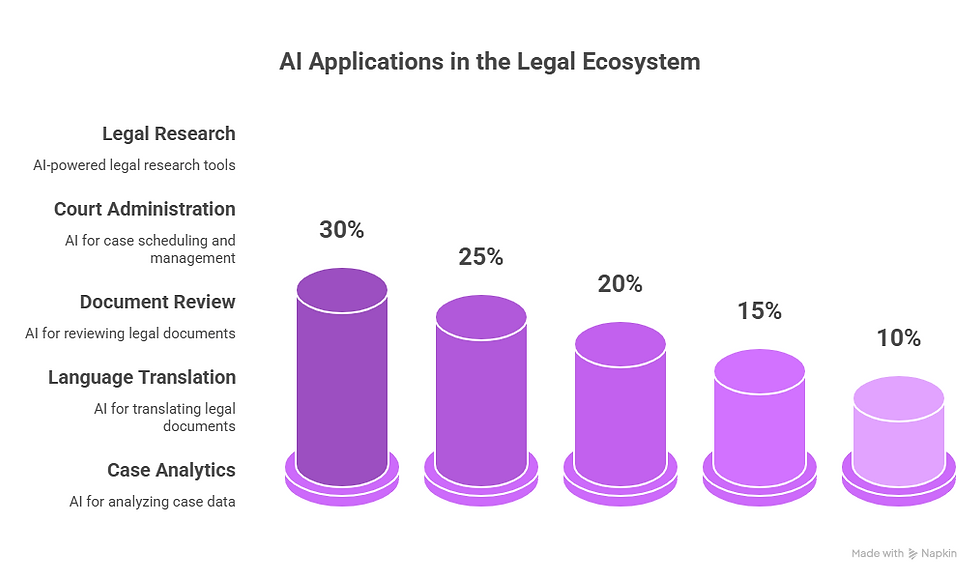
Legal research remains the most widely adopted application, followed by court administration and document review, language translation and lastly case analytics.
The Role of Lawttorney.ai in Litigation Support:
Among emerging platforms, Lawttorney.ai represents a specialized tool aimed at supporting the legal community. Designed with Indian legal workflows in mind, it assists lawyers with tasks such as:
Retrieving relevant case law
Generating structured legal drafts
Refining legal documents
Organizing litigation materials
By integrating research and drafting support into a single workflow, such tools help lawyers reduce time spent on repetitive tasks and focus on legal strategy and client representation.
The Future of AI in Indian Courts:
Legal experts increasingly acknowledge that technology will play a critical role in improving the efficiency of the justice system. Judicial leaders have emphasized that AI should support—not replace- judges, and must be implemented in a manner consistent with constitutional values such as fairness and transparency.
As digital infrastructure expands and legal datasets become more structured, the integration of AI in Indian courts is expected to grow. Future developments may include:
Intelligent case scheduling
Automated legal research assistance for judges
predictive analytics for case management
multilingual access to judgments and legal records
These developments could significantly reduce procedural delays and enhance access to justice.
Way forward: The Expanding Role of AI in Indian Courts:
The adoption of AI in Indian courts represents a gradual yet transformative shift in the administration of justice. By assisting judges with research, enabling translation of judgments, and supporting lawyers with advanced legal tools such as Lawttorney.ai, artificial intelligence is helping modernize India’s judicial system.
While human judgement remains central to the legal process, AI offers powerful capabilities to manage information, reduce delays, and enhance the efficiency of litigation support. As government initiatives and legal technology platforms continue to evolve, AI will likely become an integral component of India’s future judicial infrastructure.
Adopt AI-powered legal tools today to streamline litigation preparation and stay ahead in the evolving legal profession.



Comments