
Step-by-step: Using AI in drafting Petitions, Notices and Agreements

Introduction:
The integration of AI in Drafting is rapidly transforming how Indian lawyers prepare petitions, legal notices, and agreements. Traditionally, drafting has been a time-intensive process requiring extensive research, formatting, and repeated revisions. However, with increasing case volumes and client expectations for faster delivery, legal professionals are adopting AI-powered tools to enhance both speed and accuracy.

Recent data shows that 49% of lawyers now use AI for drafting assistance, while 43% rely on AI for document automation, highlighting a clear shift toward technology-enabled workflows. At the same time, AI tools can process thousands of documents per hour and reduce drafting time significantly, enabling lawyers to focus more on legal strategy rather than repetitive work.
In this evolving landscape, AI in Drafting is not replacing lawyers—it is empowering them to produce more structured, accurate, and efficient legal documents.
Understanding AI in Legal Drafting:
AI drafting tools use natural language processing (NLP) and machine learning to assist in creating legal documents. These systems are trained to understand legal language, structure, and formatting, enabling them to generate drafts based on user input.
Key drafting areas include:
Petitions and pleadings
Legal notices
Contracts and agreements
Affidavits and applications
AI tools help reduce manual effort while maintaining consistency and improving document quality.
Step-by-Step: How AI in Drafting Works in Legal Practice:
Below is a structured workflow demonstrating how lawyers can integrate AI into drafting tasks:

This step-by-step approach highlights how AI in Drafting simplifies complex legal writing while preserving professional oversight.
Practical Application: Drafting with AI:
1. Drafting Petitions
AI tools can generate structured petitions by:
Organizing facts into legal format
Suggesting relevant provisions
Creating prayer clauses
Lawyers can then refine the output to match case-specific requirements.
2. Drafting Legal Notices
AI helps standardize notice drafting by:
Generating legally sound language
Ensuring clarity and tone
Reducing drafting time
This is especially useful for high-volume legal practices.
3. Drafting Agreements
For contracts and agreements, AI tools:
Suggest clauses based on context
Identify risks and inconsistencies
Maintain formatting consistency
Studies indicate AI-driven contract tools can reduce review and drafting time by 40–60%.
Role of Legal AI Tools (Brief Overview):
Several AI tools are being used globally and in India to support drafting:
Lawttorney.ai – Assists with legal drafting, research, and document refinement tailored to Indian law
Manupatra / SCC Online – Provide legal databases with advanced search features
CaseMine – Helps identify relevant precedents
Global tools like CoCounsel or Harvey AI – Support drafting and legal workflows
These tools are increasingly becoming part of everyday legal practice, especially in drafting-intensive work.
Government Initiatives Supporting AI in Drafting:
The Indian judiciary has also taken steps toward integrating AI:
SUPACE (Supreme Court Portal for Assistance in Court Efficiency) helps judges with legal research and document handling
SUVAS (AI translation tool) enables multilingual legal drafting and access
e-Courts Project focuses on digitization and automation of court processes
Additionally, AI tools are being used for transcription and research assistance in courts, improving drafting accuracy and documentation efficiency.
These initiatives reinforce the growing importance of AI in Drafting within the legal ecosystem.
Pie Chart: Use of AI in Drafting Tasks:
Below is a simplified distribution of how AI is used in legal drafting:
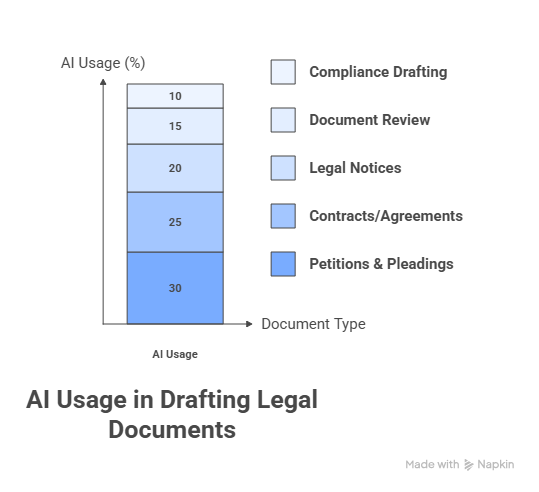
This shows that petitions and contracts form the largest share of AI-assisted drafting tasks.
Benefits of AI in Drafting
1. Time Efficiency
AI reduces drafting time significantly. Reports suggest lawyers can save hours per document, especially in repetitive drafting tasks.
2. Improved Accuracy
AI tools achieve 90–95% accuracy in document review, helping reduce human errors.
3. Consistency in Documents
Standardized templates ensure uniform drafting across cases.
4. Cost Reduction
Automation reduces dependency on manual drafting and lowers operational costs.
5. Better Productivity
Lawyers can focus on strategy and client interaction instead of repetitive tasks.
The Role of Lawttorney.ai in Drafting:
Among emerging platforms, Lawttorney.ai plays a significant role in advancing AI in Drafting within the Indian legal system. It combines:
Legal research
Draft generation
Document refinement
By integrating these functions into a single workflow, it enables lawyers to:
Draft faster
Maintain legal accuracy
Improve overall productivity
The platform is positioned as an assistive system that enhances efficiency while keeping legal decision-making entirely in the hands of professionals.
Challenges to Consider:
While AI offers multiple advantages, certain considerations remain:
Need for human validation
Data confidentiality concerns
Dependence on quality legal datasets
Learning curve for new users
These factors highlight that AI should be used as a support tool, not a substitute for legal expertise.
Way forward: The Future of AI in Drafting:
The adoption of AI in Drafting represents a major shift in how legal documents are prepared in India. By combining research, drafting, and review into a seamless workflow, AI tools are helping lawyers save time, reduce errors, and improve efficiency.
With government initiatives like SUPACE and SUVAS supporting digital transformation, and platforms such as Lawttorney.ai enabling structured legal drafting, the legal profession is steadily moving toward a more technology-driven future. As adoption continues to grow, AI will become an indispensable part of legal drafting—enhancing, not replacing, the role of lawyers.
Start using AI in drafting today to create faster, smarter, and more accurate legal documents.
FAQ Section:
What is AI in drafting?
AI in drafting refers to the use of artificial intelligence tools to assist lawyers in preparing legal documents such as petitions, notices, and agreements AI can generate structured drafts, but final review and approval must always be done by a lawyer.
Can AI draft legal documents completely?
AI can generate structured drafts, but final review and approval must always be done by a lawyer.
How much time can AI save in drafting?
AI can reduce drafting time by 40–60% depending on the complexity of the document.
Is AI drafting accurate?
AI tools can achieve high accuracy, but human validation is essential to ensure legal correctness.
Which tools are commonly used for legal drafting?
Tools like Lawttorney.ai, Manupatra, SCC Online, and global platforms like CoCounsel support drafting workflows.


Comments